As data centres grow, maintaining visibility across the site becomes more difficult. Contractor activity increases, customer requirements evolve and security information often becomes spread across multiple systems, teams and suppliers.
The impact of security and resilience failures
can be significant.
Data centre outages are estimated to cost UK organisations around £700 million in lost productivity. And in July 2022, the failure of two data centres supporting an NHS trust
resulted in £1.4 million in unplanned technology costs after clinical systems across three hospitals were disrupted.
Access control, CCTV, monitoring, intelligence and on-site security may all be performing well individually. When information sits across separate systems and suppliers, however, it becomes harder for your team to build a complete picture of risk and respond quickly when something changes.
At
SecuriGroup, we combine
intelligence,
technology and
people to support organisations operating critical infrastructure, telecommunications networks and high-security environments where visibility, resilience and rapid response are essential.
Common Data Centre Security Risks
Data centre environments have unique security needs.
Customer expectations, uptime commitments, audit requirements, contractor activity and critical infrastructure protection all place demands on security teams.
Security measures need to protect the facility while supporting operational continuity and efficient day-to-day operations.
Unauthorised Access
Controlling who can enter the facility, and where they can go once inside, remains one of the most important aspects of data centre security.
Whether it's an unauthorised visitor, a compromised credential or a failure in site procedures, access incidents can expose critical infrastructure, customer environments and sensitive information to unnecessary risk.
Insider Threats
Employees, contractors, and suppliers often require access to restricted areas as part of their role.
Without clear oversight, permissions management and audit trails, organisations can struggle to identify inappropriate access, policy breaches or activity that increases operational risk.
Operational Disruption
Not every security incident involves malicious intent.
Access control failures, contractor non-compliance, delivery issues and procedural breakdowns can all affect site operations. In environments where uptime is critical, even relatively minor disruptions can have wider consequences.
Activism and Emerging Threats
As digital infrastructure becomes increasingly important, data centres are attracting more attention from activists, organised groups and other threat actors.
Understanding the wider threat landscape helps organisations assess risk, adapt security measures, and strengthen resilience against evolving threats.
Contractor and Visitor Management
A typical data centre can see a constant flow of engineers, contractors, maintenance teams, and customer representatives.
Managing access approvals, visit or records and authorised movements across the facility becomes more difficult as activity levels increase, particularly in environments operating around the clock.
Environmental Risks
Physical security isn't the only concern.
Fire, flooding, power disruptions, and cooling failures can all impact uptime and place critical infrastructure at risk. Security teams often play an important role in escalation procedures, incident response, and maintaining site continuity when issues occur.
Customer Requirements and Access Governance
Many data centres support multiple customers, each with different access requirements, reporting expectations, and security standards.
Maintaining visibility over who can access customer environments, server rooms, technical spaces and critical infrastructure areas helps support both customer assurance and compliance requirements.
Why Data Centre Security Becomes More Challenging as Facilities Grow
As facilities grow, managing data centre security becomes more complex. Security teams are often expected to do more with the same resources, while balancing operational demands, customer requirements, and uptime objectives.
Common data centre security challenges include:
- Investigating incidents across multiple systems
- Managing increasing contractor activity
- Maintaining visibility across multiple facilities
- Meeting customer audit and reporting requirements
- Managing multiple customer access requirements
- Coordinating multiple security providers
- Reducing reliance on manual processes
- Protecting uptime while supporting business continuity objectives
- Maintaining security standards across 24/7 operations
- Balancing security controls with operational efficiency
Customer audits, compliance reviews, and security assessments frequently require clear records of access activity, contractor movements, and incident management.
When information is stored across multiple systems, preparing for these requests can become time-consuming and resource intensive.
These challenges are often what prompt organisations to review their data centre security strategy. Existing measures may still be performing adequately, but they no longer provide the visibility, coordination and operational oversight needed to support a growing facility.
The Hidden Cost of Fragmented Security
Security environments rarely stand still.
New technologies are introduced, compliance requirements evolve, and additional providers are often brought in to address specific challenges.
While each change may strengthen security in its own right, it can also create greater operational complexity.
Individual security measures may be performing well, while information remains spread across multiple systems, suppliers and teams. This makes it harder to understand how those measures are performing together.
Access control activity, CCTV footage, visitor records, monitoring alerts, incident reports and threat intelligence are often held in separate platforms, making it harder to build a complete picture of what's happening.
When information is fragmented, investigations can take longer, reporting becomes more time-consuming and emerging risks become more difficult to identify.
Bringing data, processes and teams together helps create faster decision-making and stronger oversight across the operation.
The Three Layers of an Effective Data Centre Security Strategy
Intelligence: Understanding Risk Before It Impacts Operations
By the time an incident reaches your site, you've already lost valuable time.
Intelligence helps security teams understand emerging risks, assess vulnerabilities, and make decisions based on current information rather than assumptions.
This can include:
- Threat monitoring
- Vulnerability assessments
- Security risk reviews
- Situational awareness reporting
- Intelligence-led planning
For data centre operators, intelligence provides context around threats that could affect sites, people and operations.
Through specialist threat monitoring, intelligence reporting and risk assessments,
SecuriGroup helps organisations understand their exposure and determine where additional action may be needed.
Technology: Turning Data into Actionable Insight
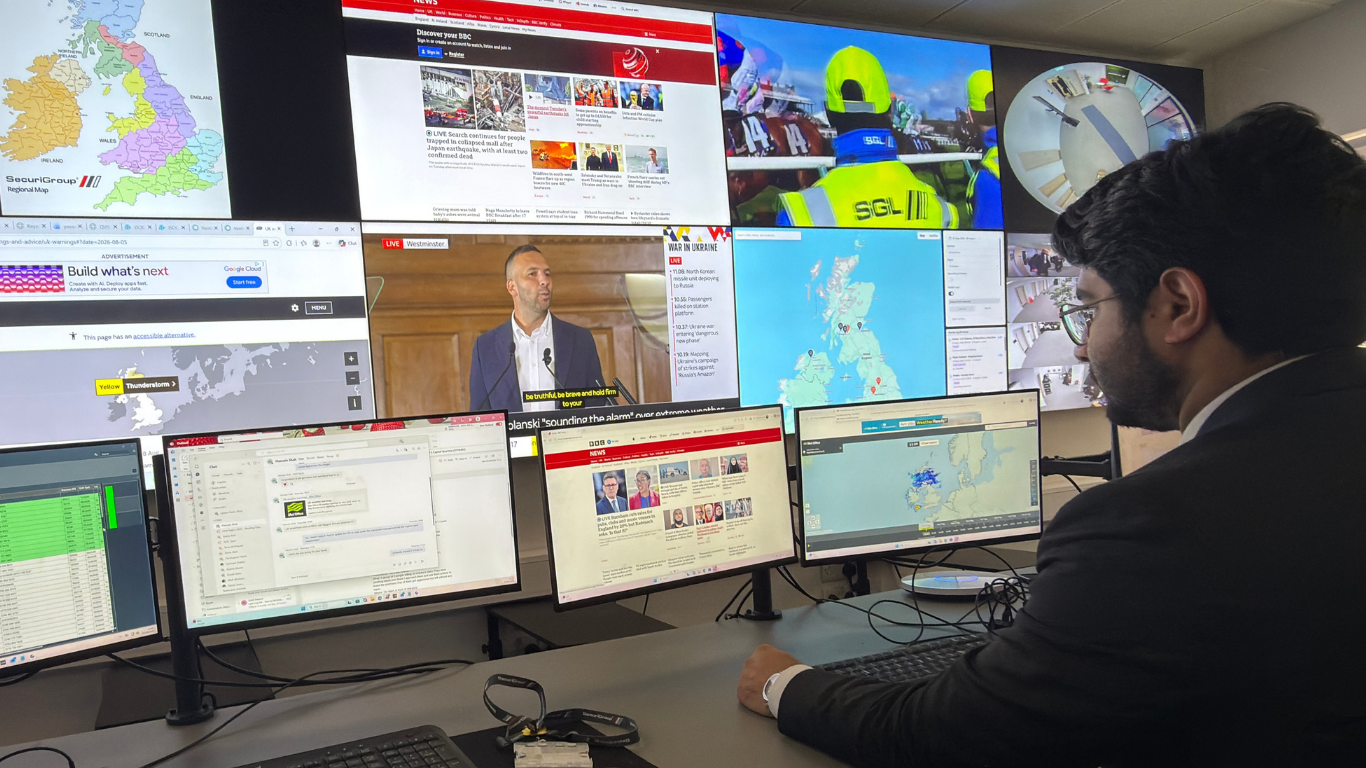
Data centres generate huge volumes of security information. Access control activity, CCTV footage, contractor records and incident reports all contribute valuable insight, but reviewing them separately can slow investigations and decision-making.
Integrated technology helps teams move from collecting data to using it effectively. By connecting monitoring, reporting and security systems, organisations can assess incidents faster, identify trends earlier and maintain better oversight of site activity.
Integrated security technologies, monitoring solutions and real-time reporting give teams the information they need to respond quickly and effectively.
People: The Critical Layer Technology Can’t Replace
Technology can highlight unusual activity. People determine what happens next.
In critical environments, security personnel can take on a much wider role than traditional
guarding responsibilities. They may manage access governance, support incident response, carry out operational checks, monitor compliance processes and act as the link between site operations, technology platforms and external stakeholders.
At SecuriGroup,
security officers are supported by specialist training, operational procedures and access to wider intelligence and technology platforms, helping them make informed decisions when issues arise.
Experience, judgement and situational awareness remain essential in high-security environments. Well-trained officers can recognise concerns that may not trigger automated alerts and take action before they develop into larger issues.
Why an Integrated Approach to Data Centre Security Delivers Better Results
If intelligence sits with one provider, technology sits with another and security personnel are managed separately, gaining a complete view of risk becomes more difficult.
An integrated approach helps you:
- Improve situational awareness
- Strengthen incident response
- Reduce blind spots
- Streamline reporting
- Improve governance
- Support compliance requirements
- Enhance operational resilience
Together, these benefits support stronger decision-making, faster responses, and more consistent security performance across the facility.
When Should You Review Your Data Centre Security Strategy?
Security reviews are often triggered by growth, change, or increasing risk.
You may be expanding to additional locations, onboarding customers with stricter security requirements or managing increasing volumes of contractors and third-party engineers across your facility.
In some cases, nothing dramatic has happened. Existing measures may be doing their job, but visibility, reporting or coordination across the site may not be as effective as you'd like.
Common signs that it's time to review your approach include:
- CCTV, access control and monitoring systems operating independently
- Multiple providers responsible for different parts of security
- Limited visibility across the site
- Growing contractor and visitor volumes
- Inconsistent reporting
- Slow incident escalation
- Difficulty identifying emerging risks
- Concerns around operational resilience
Data Centre Security in Practice: Real-World Examples
Every data centre operates differently, but the core requirements are often the same: maintaining control of access, protecting uptime, managing risk, and responding quickly when issues arise.
Many of these challenges are shared across other critical infrastructure environments, from telecommunications networks to nationally significant industrial facilities, where operational resilience is equally important.
The examples below demonstrate how integrated security strategies can help address those challenges in real-world environments.
Securing High-Risk Data Centre Environments for a Global Colocation Provider
The challenge
A global colocation provider required a security solution capable of protecting highly sensitive facilities while maintaining strict access governance and supporting a busy flow of contractors, visitors and operational personnel.
How SecuriGroup helped
- Access control and visitor verification procedures
- Reception and front-of-house security services
- Site patrols and control room management
- Pre-scheduled visitor management processes
- Behavioural Detection Awareness training
- Hostile Reconnaissance training
- Protestor Management training
- Security training aligned to data centre environments and NPSA guidance
The result
Greater control over site access, stronger visitor governance and enhanced preparedness for emerging security threats.
Why Organisations Choose SecuriGroup for Data Centre Security
Data centre operators need to protect uptime, support compliance requirements and maintain high security standards in increasingly complex environments.
SecuriGroup brings together intelligence, technology and operational security within a single strategy, helping organisations improve oversight, coordinate responses and manage risk more effectively.
Our integrated model provides:
- Greater visibility across your site
- Better coordination between security functions
- Improved threat awareness
- Faster incident response
- Reduced reliance on multiple suppliers
- Stronger operational resilience
- A security strategy that can evolve alongside your facility
Whether you're reviewing existing arrangements, developing a new facility or improving visibility across multiple locations, we help create security solutions that align with the way your operation actually runs.
Security Investment Should Deliver Visibility, Not Complexity
If you're reviewing your data centre security strategy, focus on whether your current approach provides the oversight, responsiveness and resilience needed to support your operation as it grows.
Effective
data centre security combines intelligence, technology and experienced personnel to reduce risk, support uptime, and improve operational resilience.
Looking to strengthen security across your data centre environment?
Speak to SecuriGroup about creating a tailored security strategy that aligns with the way your facility operates.